

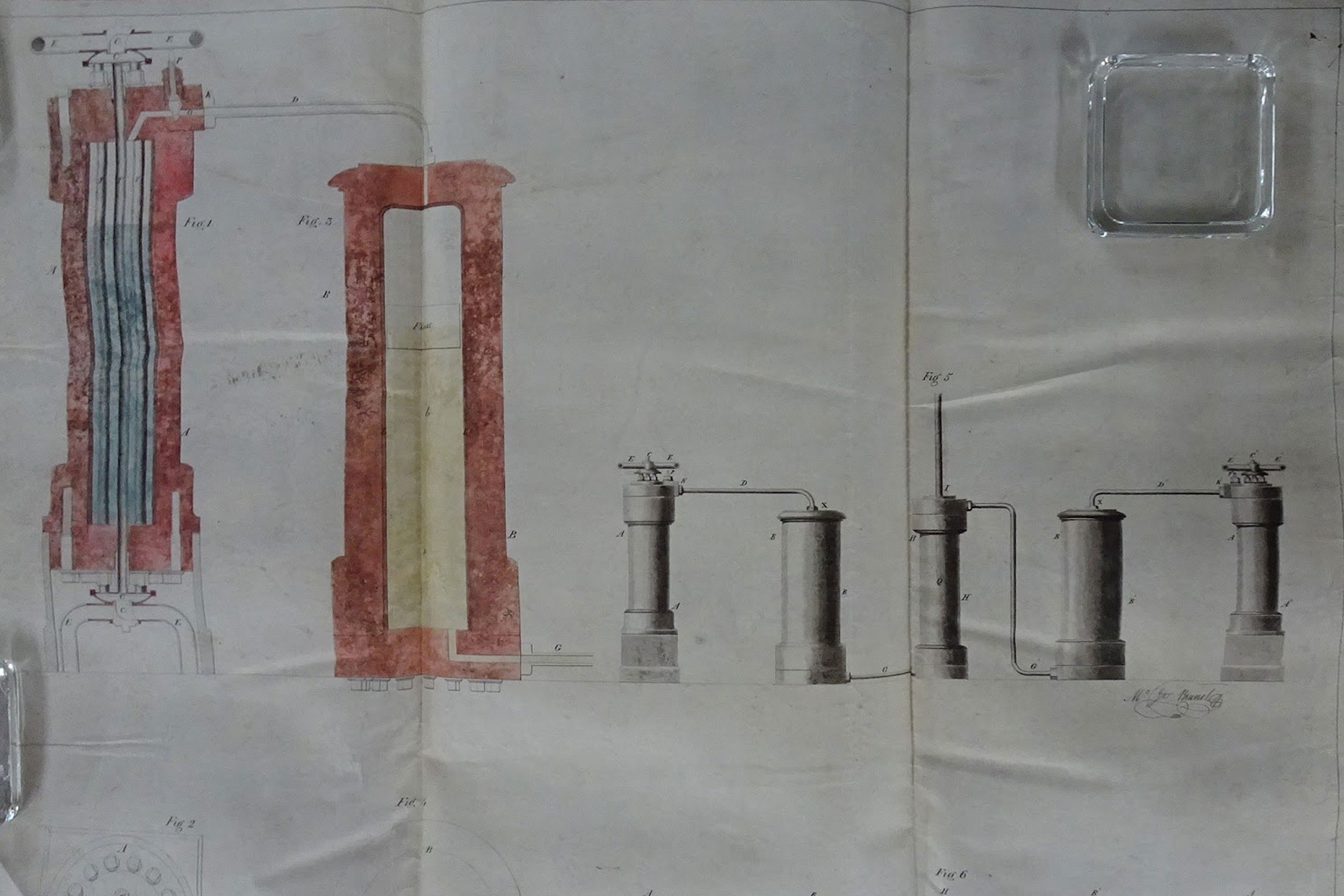
‘Better than Steam? Davy, Faraday, the Brunels & the Gaz Engine, 1823-1833’ by Professor Frank James
November 18 @ 6:00 pm - 7:30 pm
Image Credit: Crown copyright, photograph by Frank James
This event is both an in-person and on-line event. No need to register – just come along or click this zoom link to join on-line.
In early March 1823, laboratory assistant Michael Faraday, at the Royal Institution, unintentionally subjected chlorine to a very high pressure and, much to his surprise, found that it turned into a liquid – the first time that a gas had been liquefied.
Aside from the scientific achievement, very quickly this phenomenon came to be seen as having the potential to be a new source of power. Steam-power was not necessarily seen as inevitably replacing wind or water-power. This is illustrated by the large amount of effort devoted by savants, including Faraday and Davy, during the 1820s to exploit gas liquefaction practically in what was termed the ‘gaz engine’. Furthermore, the engineers Marc Brunel and his son Isambard Brunel also devoted considerable effort to render gaz engines feasible. The Admiralty, then beginning to use steam-powered vessels, was also very interested in gaz engines and provided limited support for later stages of the research.
Following repeated failures to develop a practical engine, at the start of the 1830s work ceased on the project. In modern terms, what was being attempted of course was to obtain more energy from a gaz engine than was required to liquefy the gas in the first place, that is a form of perpetual motion. Once the laws of thermodynamics had been formulated during the 1840s, the pursuit of such a source of power was seen as clearly impossible. Before then it was not clear, even to leading savants and engineers, that what they were doing was seeking to build a perpetual motion machine.
The story illustrates just how invisible perpetual motion could be.
About the Speaker
Professor Frank James, a former President of the Newcomen Society, is Professor of the History of Science at University College London. His main research centres on the physical sciences in the late eighteenth and early nineteenth centuries and how they relate to other areas of society and culture, for example art, literature, business, media, religion, engineering and the military.
Frank edited the Correspondence of Michael Faraday, published in six volumes between 1991 and 2012, served as an advisory editor for the four volume Collected Letters of Humphry Davy (2020) and was a Co-I on the AHRC funded Humphry Davy Notebooks Project. His Michael Faraday: A Very Short Introduction was published in 2010 by OUP who the following year also published his sesquicentenary edition of Faraday’s Chemical History of a Candle.
His current research concentrates on writing and researching a biographical study of Humphry Davy focussing on his practical work including nitrous oxide, agricultural chemistry, mineralogy, the miners’ safety lamp, analysis of ancient Roman pigments and his attempts to unroll chemically the papyri excavated from Herculaneum.